Anime Figure Shelf Spacing Guide: How Much Room Do You Really Need?
Planning an anime figure shelf is usually where collectors discover that "it should fit" is not the same as "it will display well." A shelf can technically hold a figure and still be wrong because the base sits too close to the front edge, the hair or weapon nearly scrapes the shelf above, or a dynamic pose forces every neighboring piece to stand farther apart than expected.
Good anime figure shelf spacing is about more than figure height. You need enough vertical clearance, enough depth for the base and overhang, and enough side-to-side breathing room so the display does not turn into a crowded wall of plastic and effect parts. If you plan those three dimensions well, your shelves look cleaner, your figures are safer, and your future purchases stop becoming layout problems.
This guide focuses on practical measurement logic for collectors choosing an anime figure display shelf, a cabinet, or a room layout. Instead of guessing, use these spacing ranges as planning numbers and then add a little margin for pose, accessories, and future expansion.
Why shelf depth and height matter more than total shelf size
Collectors often shop by overall furniture dimensions first. That matters for the room, but the more important numbers are the usable dimensions of each shelf opening.
A shelf can look large from the outside and still underperform if:
- the interior depth is shallow once the back panel is counted
- the shelf height is fixed at awkward intervals
- thick front framing steals visual space
- lighting channels, doors, or lips reduce the practical front edge
For shelf planning, think in three measurements:
- usable height: from shelf surface to the underside of the shelf above
- usable depth: from the back panel to the safe front placement line
- usable width: the real display width after supports, brackets, or dividers
A simple rule works well for most collectors: do not plan for a figure using its manufacturer-listed height alone. Plan for the real footprint of the figure in display posture.
That means checking:
- base diameter or base width
- widest arm, hair, wing, cape, or weapon spread
- highest point of the pose, not just the character's head
- whether the figure leans forward or backward relative to the base
If your main goal is better visual balance after everything fits, this display layout guide pairs well with spacing planning: How to Display Anime Figures Without Making Your Shelf Look Cluttered.
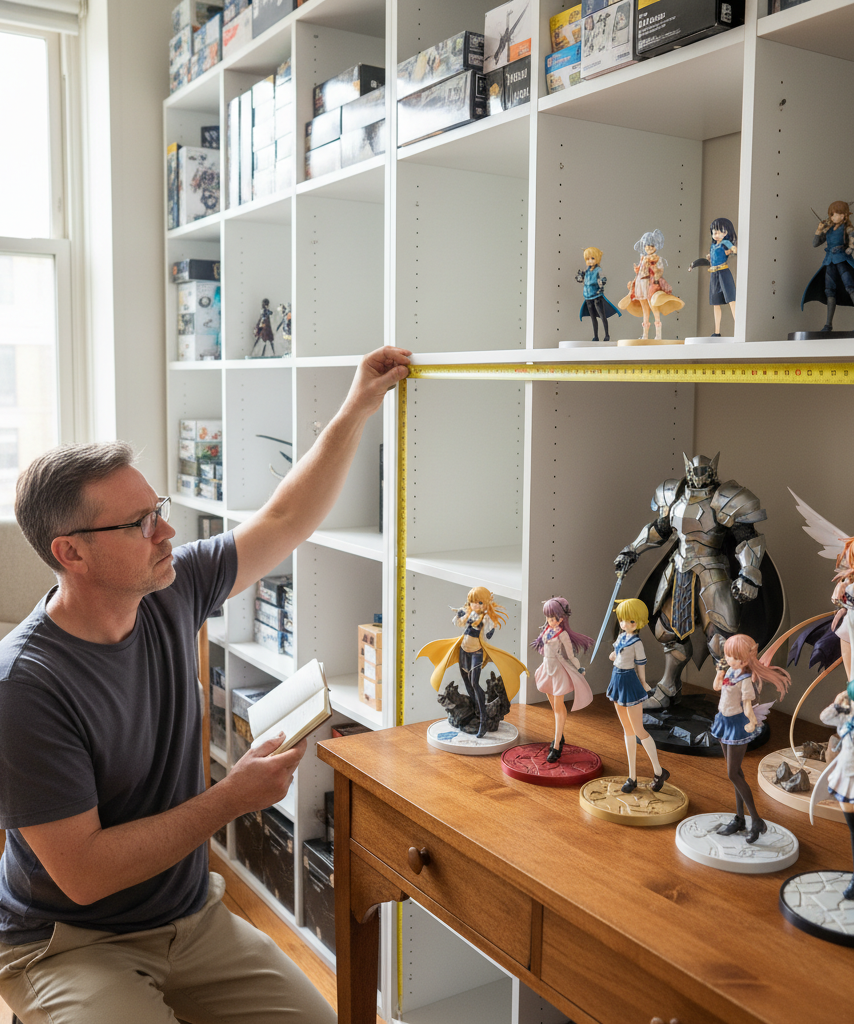
Shelf spacing by figure type
There is no universal shelf size for every anime figure, but planning ranges make furniture decisions much easier. The numbers below are practical starting points rather than hard laws.
Nendoroids and other small chibi figures
Nendoroids, look-up figures, and similarly compact display pieces usually need the least depth and height, but they can still eat more width than expected when you display multiple stands, face plates, or props.
Good planning range per shelf opening:
- height: 16 to 20 cm
- depth: 14 to 18 cm
- single-figure width allowance: 10 to 14 cm
Why this works:
- many chibi figures are short, but accessories often project outward
- shallow shelves are usually fine if you are not using oversized speech-bubble effects or arm extensions
- lower shelf heights help avoid wasting vertical space on tiny pieces
If you want a denser lineup, Nendoroids can share shelves more comfortably than larger scales, but leave enough room that face plates and raised hands do not overlap awkwardly.
Prize figures
Prize figures vary a lot, but they are often the category where collectors underestimate spacing. The figure itself may be moderate in size while the base is wide, the hair reaches back, or the pose needs more visual separation than the measurements suggest.
Good planning range per shelf opening:
- height: 24 to 30 cm
- depth: 20 to 28 cm
- single-figure width allowance: 16 to 24 cm
This range works for many common prize figures and upright posed action-style display pieces. If the pose is calm and the base is compact, you can tighten the spacing. If the figure uses flowing hair, a wide stance, or a diagonal weapon, move toward the upper end of the range.
1/8 and 1/7 scale figures
This is where shelf planning starts to matter a lot. Scale figures often have cleaner sculpt quality and better presence, but they also demand more room around them to actually look premium.
Good planning range per shelf opening:
- height: 28 to 38 cm
- depth: 24 to 35 cm
- single-figure width allowance: 18 to 30 cm
For many 1/7 scale pieces, the best anime figure shelf spacing is not just about fitting the base. It is about giving the silhouette room to read. Hair arcs, coat tails, translucent effects, and angled weapons can easily add several centimeters beyond the base edge.
If you collect a lot of scale figures, adjustable shelf height matters more than almost any decorative cabinet feature.
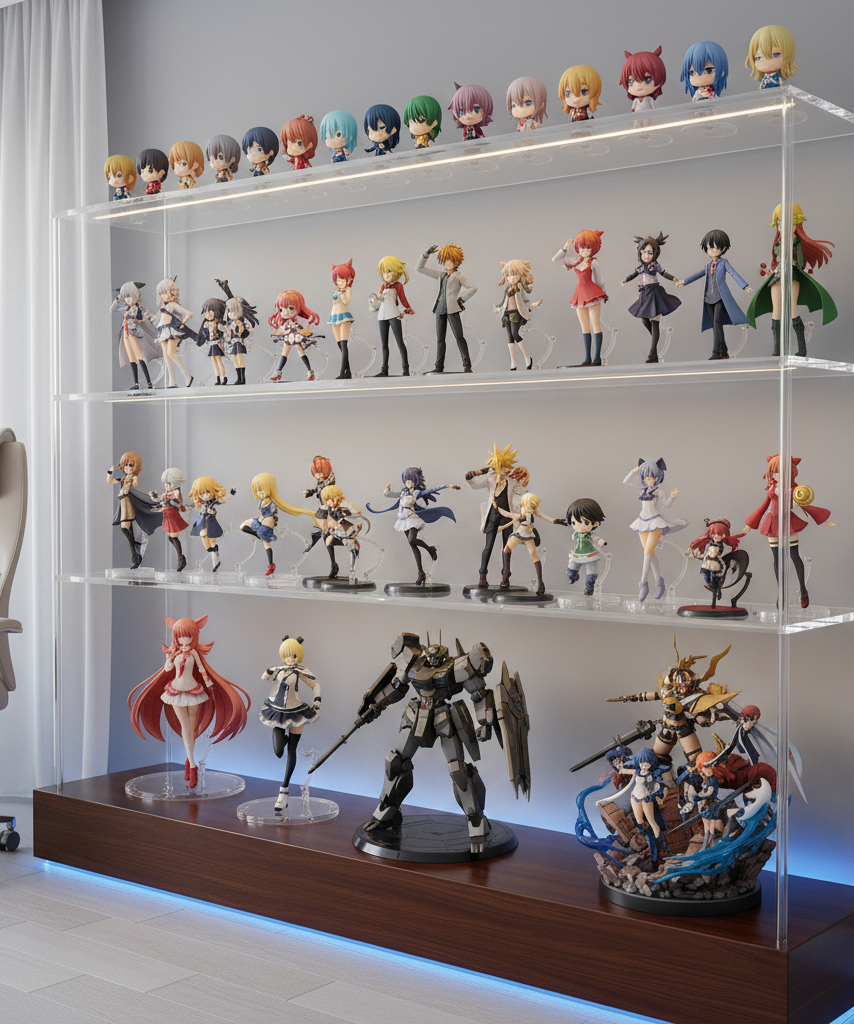
Large statues and dynamic display pieces
Statues and premium display pieces are where collectors most often outgrow a shelf they thought was "deep enough." The issue is not only size. It is irregular shape.
Good planning range per shelf opening:
- height: 38 to 55 cm or more
- depth: 32 to 45 cm or more
- single-piece width allowance: 28 to 50 cm or more
For statues, measure the whole visual footprint, including:
- cape flare
- weapon extension
- effect parts
- rock or environmental base spread
- leaning angle toward the front glass or shelf edge
This is also where weight rating starts to matter. A shelf may have enough space but still be a bad idea if it flexes under resin or a heavy multi-part base.
Leave extra room for dynamic poses, accessories, and maintenance
Many shelf mistakes happen because collectors plan around the calmest possible outline of a figure rather than its actual displayed shape.
Add extra clearance when your figure has:
- swords, staffs, rifles, or long horizontal props
- wing spans or hair strands that extend behind the body
- translucent splash, smoke, or magic effect parts
- companion pieces, alternate arms, or floating supports
- a leaning or lunging pose that projects forward
A useful planning shortcut is this:
- for simple upright figures, add about 2 to 4 cm beyond the base edge on each side where possible
- for dynamic scale figures, add about 4 to 8 cm of extra side or front allowance depending on the pose
- for large statues, add enough space that no major part feels visually pinned against the shelf wall or neighboring figure
Do not forget maintenance space either. If a shelf is packed so tightly that you cannot lift a figure out safely without moving three others first, the spacing is too aggressive for real use.
Front-edge safety margin
Do not place the base right at the front edge just because the depth technically allows it. Leave a front safety margin so the figure feels stable and the display looks intentional.
A good practical margin is:
- 2 to 3 cm for small figures
- 3 to 5 cm for prize and most scale figures
- more when a figure leans forward or uses a heavy front-loaded pose
That buffer protects the visual balance and lowers the chance of accidental bumps during cleaning.
How to plan future expansion without replacing the shelf too soon
A lot of collectors buy shelves based on the current collection and then lose flexibility after just a few purchases. The safer approach is to plan for the next phase of the hobby, not only the current phase.
Use these questions before buying shelves for anime figures:
- Do you mostly collect one format, or are you moving from prize figures into scales and statues?
- Do you prefer dense storage, or do you want each centerpiece to breathe visually?
- Are you likely to add effect-heavy figures from the same franchise line?
- Will you want room for risers, acrylic steps, or lighting later?
- Is your shelf system modular enough to expand sideways or upward?
A smart planning method is to dedicate shelf zones:
- one tighter zone for Nendoroids and compact figures
- one medium-depth zone for prize figures
- one taller, deeper zone for scale figures and future statement pieces
That mixed strategy usually performs better than buying one uniform shelf grid and forcing every figure type into it.
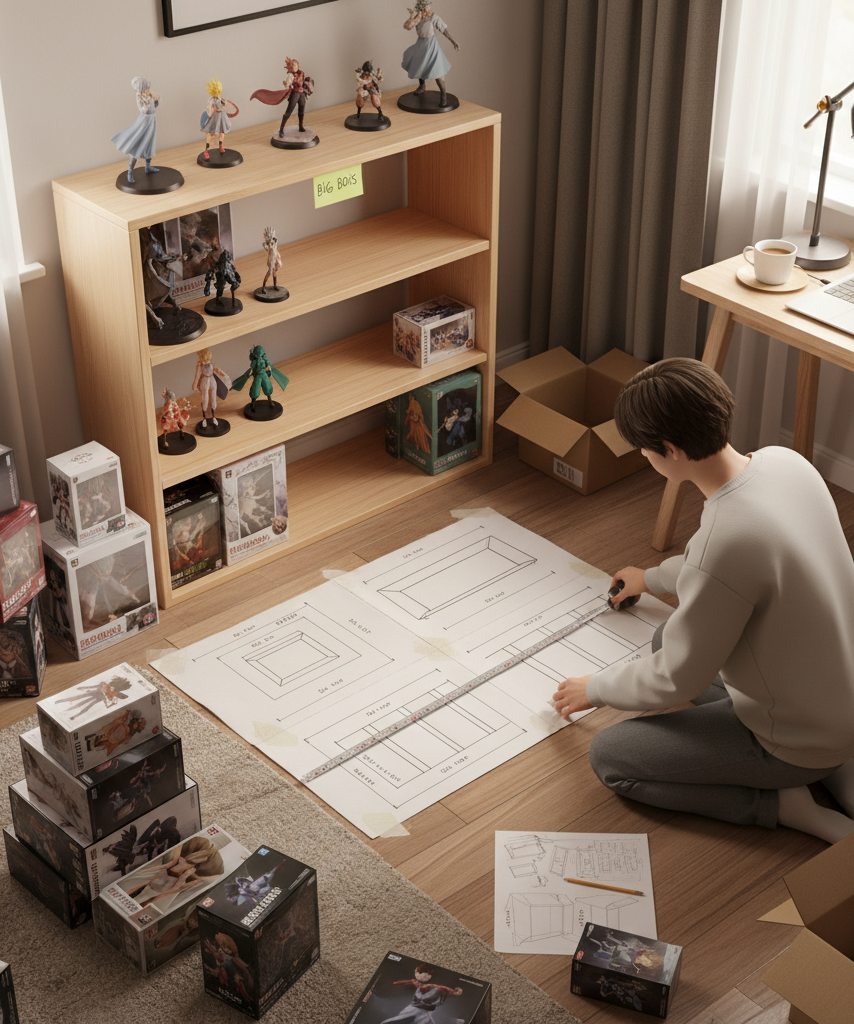
Common shelf setup mistakes that waste space
Even collectors who buy large shelves can waste a lot of display room through bad spacing decisions.
Mistake 1: judging by figure height only
A figure that is 25 cm tall may still need a 30 cm opening once hair spikes, raised arms, or the top of the base composition are counted.
Mistake 2: buying shelves that are too shallow
Depth is often the real bottleneck. Many shelves look stylish but feel cramped once you place a wide circular base, especially for 1/7 scales and statues.
Mistake 3: leaving no negative space
If every figure touches the next one visually, the whole shelf starts to look smaller. Negative space is not wasted space. It is what makes the collection readable.
Mistake 4: forgetting the cabinet door or front frame
In enclosed cabinets, the usable space may be smaller than the interior measurement suggests because the frame or door swing changes how comfortably a figure can sit near the front.
Mistake 5: planning no "upgrade margin"
A collector who starts with compact prize figures often eventually buys larger scales. If every opening is optimized only for the smallest current figures, the furniture becomes disposable too soon.
A simple spacing formula collectors can actually use
When you are unsure how much room to allow, use this simple planning formula:
required shelf space = figure footprint + display breathing room + safety margin
In practice, that means:
- start with the widest, deepest, and tallest real point of the figure
- add visual breathing room so the silhouette is not cramped
- add a small front and top margin so placement and removal stay safe
If you do not know the exact manufacturer measurements yet, plan conservatively. A slightly oversized shelf is usually fixable with risers, grouping, and layout work. A shelf that is too shallow or too short is just a recurring annoyance.
Final answer: how much room do you really need?
For most collectors, the right answer is not "as much as possible." It is enough room for the figure's full silhouette, plus a little margin for safety, readability, and future growth.
As a practical summary:
- Nendoroids / small figures: around 16 to 20 cm high and 14 to 18 cm deep
- Prize figures: around 24 to 30 cm high and 20 to 28 cm deep
- Scale figures: around 28 to 38 cm high and 24 to 35 cm deep
- Statues: often 38 cm+ high and 32 cm+ deep, sometimes much more
If you want your anime figure display shelf to look intentional rather than improvised, measure the whole figure footprint, not just the headline height. That one habit saves money, shelf frustration, and a lot of awkward rearranging later.