How to Pack Anime Figures for Moving Without Breaking Parts, Paint, or Boxes
To pack anime figures for moving safely, separate delicate parts, use soft non-abrasive wrapping, protect original boxes from crushing, and prevent movement inside each box before stacking anything for transport.
Moving anime figures is different from routine shipping. In a move, boxes may sit in a hot car, get stacked under household items, or shift multiple times before they reach the new display room. That means the safest approach is not just adding more bubble wrap. It is controlling pressure, friction, and empty space so your figures, blister trays, accessories, and collector boxes all stay stable.
If you are wondering how to pack anime figures for moving, the short version is this: keep boxed figures supported but not crushed, pack unboxed figures in layers that do not rub against paint, and use small, clearly labeled moving boxes instead of one oversized box full of risk.
Quick Answer: Safest Packing Priorities
Before you start wrapping anything, focus on these priorities in order:
- Remove or secure delicate parts that can snap under side pressure.
- Prevent paint rub by avoiding direct friction between figure surfaces and rough packing material.
- Stop internal movement inside each figure box or storage container.
- Protect original packaging and blister trays from being bent or crushed.
- Use small to medium moving boxes that stay light enough to carry flat and steadily.
- Label boxes by fragility, orientation, and collection section.
A good packing job protects more than the main body of the figure. It also protects hair strands, weapons, pegs, bases, support rods, blister trays, and collector boxes that matter for presentation, storage, and future resale.
Supply Checklist: What to Use and What to Avoid
Best Supplies for Moving Anime Figures
Use supplies that cushion without scratching:
- acid-free tissue paper or soft packing paper
- clean microfiber cloths for highly delicate painted areas
- polyethylene foam sheets or other smooth foam padding
- bubble wrap used over a soft barrier layer, not directly on sensitive paint when risk is high
- painter's tape or low-tack tape for securing outer wrap layers
- zip bags or small labeled parts bags for accessories
- sturdy small moving boxes
- cardboard dividers for separating boxed figures
- silica gel packets if figures may sit in temporary storage
- a thick marker for orientation labels such as "FRAGILE," "THIS SIDE UP," and "DO NOT STACK HEAVY ITEMS"
Packing Materials to Avoid
Some common packing shortcuts cause the exact damage collectors hate most:
- newspaper directly against figures, because ink can transfer
- strong tape directly on boxes, blisters, or figure surfaces
- loose fill peanuts touching paint or tiny accessories
- wrapping painted parts tightly in bubble wrap with pressure on spikes, hair tips, or glossy finishes
- oversized boxes with too much empty space
- grocery bags or thin plastic that can trap moisture and create surface rubbing
Boxed vs. Unboxed Packing Comparison
| Figure condition | Best starting point | Main risk during the move | Best protection method |
|---|---|---|---|
| Boxed figure with original blister tray | Keep in original box if it still fits correctly | Outer box crushing or internal shifting | Fill empty gaps lightly, protect corners, place in snug moving box |
| Boxed figure with damaged or loose blister | Rebuild support around the inner contents | Figure moving inside original packaging | Add soft stabilizing filler outside the figure and around the blister, then double-box if needed |
| Unboxed PVC figure | Separate removable parts first | Paint rub and snapped details | Wrap with soft barrier, support shape, immobilize in a compartmented box |
| Unboxed resin statue | Minimize handling and vertical stress | Heavy weight cracking joints or thin extensions | Use dense foam support, custom spacing, and very limited stacking |
| Figure with many accessories | Bag and label everything individually | Lost parts and scratching between items | Separate all accessories and store them in labeled bags within the same container |
Step-by-Step: How to Pack Boxed Figures
Original packaging is often the safest option, but only if it still holds the figure properly. A loose blister tray is not automatically protective just because it is original.
1. Inspect the figure box before packing
Check whether the blister tray still closes correctly and whether any plastic windows, inner flaps, or cardboard inserts have warped. If the figure can slide inside the packaging, fix that before moving on.
2. Remove pressure-sensitive extras if needed
If bonus parts, alternate hands, faceplates, or effect pieces are rattling around, move them into small labeled bags or secure their tray compartments so they cannot jump free during transport.
3. Support empty gaps without overstuffing
If the original box has loosened over time, use soft acid-free tissue or smooth foam around the blister, not hard pressure directly on the figure. The goal is to stop movement, not clamp the figure tighter.
4. Protect the collector box itself
Place the figure box inside a secondary moving box with padding around all sides. This is the best way to protect collector boxes from corner dents, crushed edges, and surface scuffs during a larger move.
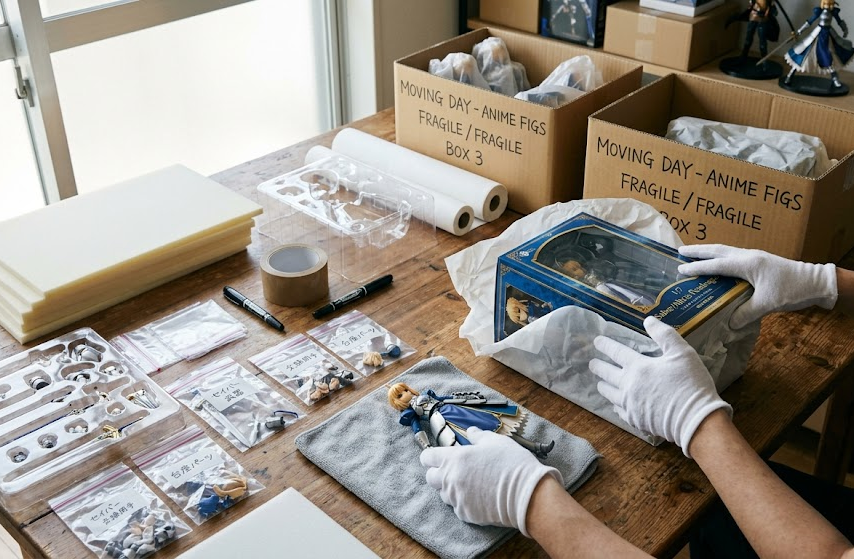
5. Pack upright when the box structure depends on it
Some collector boxes resist side pressure better when kept upright. If the packaging has a large front window or delicate top flap, mark orientation and keep stacking pressure off that panel.
Step-by-Step: How to Pack Unboxed Anime Figures With Delicate Parts
If you display your collection without boxes, your biggest enemies are friction, pressure points, and mixed accessories. This is where most moving anime figures damage happens.
1. Photograph the display before disassembly
Take quick reference photos so you know where each base, support rod, faceplate, and accessory belongs later. This also helps if you own several similar figures from the same line.
2. Remove detachable parts first
Take off weapons, wings, tails, base pegs, support arms, alternate hands, and any loose ornaments. Delicate parts should not stay attached if they can turn into leverage points during a move.
3. Wrap the main body with a soft barrier layer
Start with acid-free tissue paper, soft packing paper, or a clean microfiber cloth around painted areas. This barrier reduces paint transfer and prevents textured bubble wrap from pressing directly into glossy or soft finishes.
4. Add cushioning without crushing sculpted details
After the barrier layer, add foam or a loose outer bubble-wrap layer. Keep pressure away from hair tips, fingers, ribbon ends, and narrow ankles. For figures with dramatic poses, build support around the silhouette instead of squeezing the widest points.
5. Pack each figure in its own compartment
Do not let wrapped figures collide in one open box. Use dividers, snug compartments, or individual inner boxes. Every anime figure should stay immobilized on its own, especially if it has complex paintwork or thin sculpted parts.
6. Bag and label accessories separately
Put accessories in small bags labeled with the character or figure name. Then place those bags in the same compartment as the figure, but not where hard plastic parts can press directly into the painted surface.
7. Keep heavier pieces low and centered
For heavier resin statues or large bases, place weight at the bottom of the moving box and support it evenly. Never let a heavy base lean against a lighter figure body.
How to Protect Paint, Blister Trays, and Collector Boxes
Collectors often focus on breakage first, but cosmetic damage is just as frustrating. Paint transfer, gloss marks, and box dents can happen even when nothing technically breaks.
Protecting anime figure paint
To protect paint, avoid direct rubbing, sticky materials, and prolonged pressure on one point. Bubble wrap can be useful, but bubble wrap touching paint under tight pressure is not always safe for long moves or hot conditions. A soft barrier layer is the smarter default.
Protecting blister trays
Blister trays work well when they still match the figure tightly. If the tray is cracked, warped, or too loose, treat it as only part of the protection system. Add light support around the tray so it cannot flex inside the box.
Protecting collector boxes from crushing
Collector boxes are easiest to damage at the corners, front window, and top panel. To protect anime figure boxes from crushing:
- use outer cartons only slightly larger than the original boxes
- pad all four sides and the top and bottom
- keep the heaviest items at the bottom of the overall load
- never stuff household items around figure boxes just to save space
- avoid overstacking boxes with books, kitchenware, or electronics on top
For many collectors, the original packaging matters not just for storage but also for completeness and resale value. Original packaging also helps with moving protection when it is still structurally sound.
How to Label and Stack Boxes for the Move
A perfectly wrapped figure can still be damaged by one careless stack in the truck.
Label clearly and specifically
Generic "fragile" labels are not enough. Write labels such as:
- Anime Figures – Upright Only
- Do Not Stack Heavy Items
- Open This Side First
- Accessories Inside
- Resin Statue – Carry Flat
These labels help you and anyone helping with the move make better handling decisions.
Use smaller boxes instead of one giant box
Small boxes reduce crushing force and are easier to keep upright. They also make it more realistic that you will actually carry them carefully instead of dragging or tilting them.
Keep figure boxes separate from general household loads
Do not mix collectible figures with dense items like books, tools, cookware, or cleaning supplies. The safest moving box for figures is one packed only with figure-related items.
Avoid trunk heat and long direct sun exposure
Heat softens plastics, adhesives, and some paint finishes. If possible, transport high-value figures in the climate-controlled part of the vehicle rather than leaving them in a hot trunk for hours.
Do Not Do This: Common Moving Mistakes
Avoid these collector-killer mistakes:
- do not wrap a painted face or glossy hair piece tightly in bubble wrap without a soft inner layer
- do not leave detachable parts loosely rattling in the same box
- do not use one huge carton for an entire display shelf
- do not place unboxed figures directly against corrugated cardboard edges
- do not let heavy resin pieces hang off unsupported foam gaps
- do not stack ordinary moving boxes on top of windowed collector packaging
- do not rush repacking at the last minute without labels
Summary Takeaway
The best way to pack collectible figures safely for a move is to reduce friction, remove leverage points, and eliminate empty space without creating crushing pressure. Boxed figures do best when their original packaging is still supportive and then placed inside a padded moving box. Unboxed anime figures need separate wrapping, separated accessories, and individual compartments so delicate parts and paint finishes never rub during transport.
FAQ
Should I move anime figures in their original boxes?
Yes, if the original box and blister tray still hold the figure securely. Original packaging is often the safest option for boxed figures, but loose or warped packaging should be reinforced so the figure cannot shift inside.
Can bubble wrap damage anime figure paint?
It can if bubble wrap sits directly against paint under pressure, heat, or long storage time. For moving anime figures, it is safer to place a soft barrier layer between the paint and the bubble wrap.
How do I pack unboxed anime figures for moving?
Remove detachable parts, wrap the figure with a soft non-abrasive layer, add cushioning around the shape, and place each figure in its own compartment. Keep accessories labeled and separate so they do not scratch the main figure.
How do I protect anime figure boxes from crushing?
Use a snug outer moving box, pad all sides, keep weight off the front window and top panel, and avoid stacking heavy household items on top. Smaller moving boxes are safer than oversized cartons.
Are resin statues packed differently from standard PVC figures?
Usually yes. Resin statues are heavier and can crack under uneven stress, so they need denser support, flatter carrying orientation, and more careful weight distribution inside the box.
Final Thoughts
Whether you are moving across town, rotating part of a display into storage, or transporting a collection between rooms, careful packing matters more than speed. A collector-friendly move protects the figure, the accessories, and the box together. If you build each package around stability instead of just padding, your figures are far more likely to arrive exactly the way they left.